
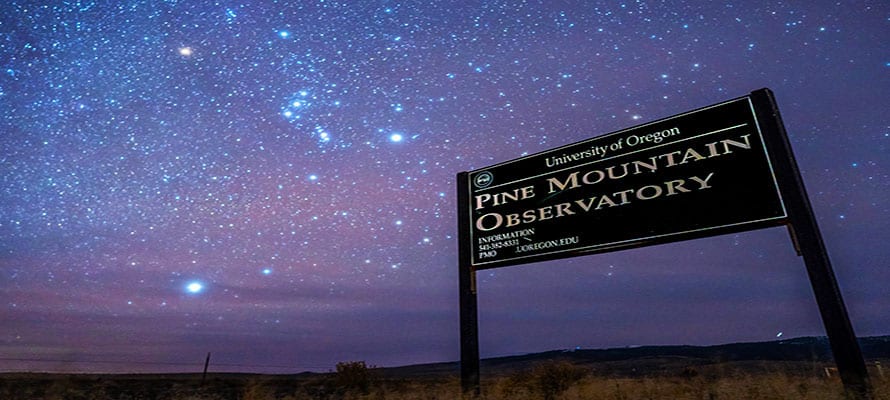
Since most current space images are created
by digital devices, like CCD cameras, and since most text is created on word
processors, a natural destination for this digitized information is the World
Wide Web (WWW) on the Internet. The WWW is a way that computers around the
world are linked together by software and hardware that allow a user to bring
images, text and other multi-media resources from any "web site" (hypertext
equipped computer) on the "net" onto the user's computer (equipped to read
hypertext documents) to view, explore, work with, save, and then to be able
to electronically jump to another source with minimum of effort.
Major astronomy sites, like the Hubble Space Telescope
Science Institute, NASA, JPL, and most Universities that have Astronomy Departments
and/or Observatories, including the University
of Oregon and Pine Mountain Observatory, as well as numerous Astronomy
Clubs and publications around the world, maintain pages and reference lists
on the WWW. Thus, students, teachers, and anyone else interested in the latest
material on astronomy technology and discoveries, can access this information
almost in real time. Furthermore, most sites include E-mail links that allow
a user to communicate directly to those subject-matter-experts who are directly
working with the observatory/experiment/topic.
Below we offer you a sampling of astronomy oriented
URLs. The simplest way to learn how Netscape, the WWW, and the Electronic
Universe works is to browse through some of these sites. There are many
other excellent sites, and we will add to and modify our list. We presently
include some of our favorite current locations, with no endorsements nor
recommendations, just the invitation for you to browse and enjoy!
Professor Greg Bothun, at the University
of Oregon, has pioneered the use of electronic media, particularly the Internet,
to promote wide-scale distribution of professional scientific information.
Greg's "Electronic Universe" project already allows the public unprecedented
access to professional sites and data, and will continue to develop strong
interactive multimedia resources so that people equipped with high-speed Internet
connectivity will be able to readily access a taste of real science first-hand.
This Web site has been set up by Greg, and although Friends of Pine Mountain
Observatory creates and edits the pages within our area, we thank and credit
Greg for his overall concept, his furnishing the hardware/software for the
site, and we encourage users to browse his pages listed below, particularly
those science educators interested in information on the latest concepts
in multi-media and distance-learning technology and projects.
-
A Place
to Start
- You will be starting from the Pine Mountain Observatory Web
Site, where you found the Friends of Pine Mountain Observatory home page.
-
Your Host: The University
of Oregon
- Professor Bothun's University of Oregon Physics Department Home
Page.
-
The University
of Oregon's Astronomy Site
- A major jump-off site to related links & courseware, including
the latest information about the possible planet orbiting the star 51
Pegasus.
-
Cassini/Huygens
- Current NASA mission to Saturn.
Mars
Exploration Rover Missions January 2004
Two rolling landers search for evidence
of liquid water.
-
Mars Surveyor/Polar
Lander
- These are the current spacecraft enroute to Mars.
-
Mars Pathfinder
- Pathfinder/Sojourner Mars Rover (This mission is over.)
-
Lunar Prospector
- The first NASA Moon mission in 25 years!
-
The
Galileo Mission
- Current updates on the Galileo mission and the spacecraft.
-
Project Galileo
- Complete Galileo mission information.
-
The Venus Magellan
Mission
- Venus Magellan mission info, images, data from JPL/NASA.
-
Space
Telescope Science Institute Press Release
- Press release listing of latest
discoveries including images.
-
Hubble's
Greatest Hits of '90-'95
- More images from the Hubble space telescope.
-
Hubble's Heritage Collection
- New compilation of Space Telescope images and information.
-
Astronomical
Chart
- Chart of comparative distances.
-
NASA Kids Liftoff to Space
Exploration
- A Richly Illustrated Introduction to Space
-
Basic
astrophysics content references
- Another NASA reference resourse.
-
Astronomy Overview
- A good overview of the hierarchy of the known Universe.
-
Current
Sky Information and Star Charts
- What to View and Where to find it, by Bruce Dale
-
Another source
of seasonal sky charts Lake Afton Public Observatory's Charts.
-
An introduction to "atomicity"
Basic atomic structure, basic chemistry.
-
Constellations-
Patterns, Stars, History, Locations A very complete coverage by
Chris Dolan, from Wisconsin.
-
Solar
System Tour from SEDS, University of Arizona.
-
Solar System Tour from
Calvin J. Hamilton, Los Alamos National Lab.
-
Solar System Tour
from JPL.
-
NASA's most current
Solar System Tour.
-
Solar System
"Orrery" A really neat imaginary view from above the Solar System,
showing current positions of planets in their orbits, relative to the Sun.
-
NASA's Planetary
Photojournal Nearly 1500 images of Planets, Moons, and Asteroids
taken by Robotic Spacecraft that have flown by these objects. Many formats
available at this site.
-
Visible Comets
NASA's information about currently visible comets.
-
Asteroid Coordinates
Where to locate the minor planets - IAU and MPC site.
-
Today's Sun
Current image of our Sun.
-
More Solar
Images Other solar image sources.
-
Aurora Borealis
Predictions of aurorae, charts of auroral areas from Alaska.
-
More Aurora
Borealis Worldwide aurora information.
-
Detailed Solar
and Lunar Eclipse info,Imagery, and Maps From Fred Espenak at NASA's
Goddard Space Flight Center.
-
Messier
Object Images University of Arizona's Messier Objects images (includes
neat thumbnail index of these "deep sky" objects).
-
Black Hole
FAQ UC Berkeley, Frequently asked Questions page.
-
Black Holes,
Types of Stars U of O's Professor Jim Schombert's introduction
to the life/death of stars.
-
Simulations
Virtual trips to Black Holes and Neutron Stars.
-
NASA NASA's home page.
-
SpaceLink
NASA news, images, educational materials.
-
Amazing
Space - projects for students Hubble Space Telescope Science
Institute's Educational Site.
-
Quest NASA's K-12
Internet Initiative.
-
More projects and
info about discovering extra-solar Planets NASA's extra-solar
planet page, also see Greg Bothun's Java Lab.
-
Jet Propulsion Lab
JPL's home page.
-
JPL Learning Link
JPL's education outreach.
-
The Science Factory
and Planetarium Formally The Lane ESD Planetarium.
-
Rose City Astronomers
The Rose City Astronomers' home page (with link to Portland's OMSI).
-
Eugene Astronomical Society
The Eugene Astronomical Society's home page.
-
Goldendale, Washington,
Observatory
- A State Park with an excellent Observatory.
-
Murdock Planetarium
- OMSI's Murdock Planetarium home page.
-
OMSI's Starlab
Planetarium
- OMSI's Starlab Planetarium home page.
-
-
-
Telescope
information Description/diagrams/photos of telescopes by Nick Strobel,
Bakersfield.
- Charge
Coupled Device (CCD) Cameras:
-
Apogee Instruments'
CCD University Many details about CCD technology
-
Professor Bothun's
CCD page Overview of current technology, details
-
Observatories
An extensive list of observatories compiled by the USGS.
-
Telescope
construction Mel Bartels' astronomy/telescope construction home
page.
-
CCD Cookbook Imaging
Richard Berry's CCD Cookbook Camera Home Page.
-
UW Astronomy Department
University of Washington's Astronomy Department - very complete.
-
Astronomical Society of the
Pacific Astronomical Society of the Pacific, another major listing
and links.
-
Astronomy
Magazine A very complete listing, including what one can see with
the naked eye in tonight's sky.
-
Sky Online Home of
Sky & Telescope magazine. Another complete listing, also
including what to see with the naked eye in tonight's sky.
-
An Interactive
Drake Equation Find out how many civilizations may exist in our
galaxy to talk to.
-
Professor Geoff Marcy's
site about finding Extra-Solar Planets
This site maintained by The Friends of Pine Mountain
Observatory.
If you have any comments or questions please send them to: Frank Gornto, WebWeaver,or to Rick Kang, FOPMO Education/Publicity Chair
Last updated 19 January 2002 by fmg.
All artwork by Amy McGrew. Not to be re-published in any form without permission.
|