
| MEASURING the SKY - An
Introduction to Digital Astronomy 2000-2001
Side 1 of 2
Name_____________________
Period _____
by Rick Kang, Public Ed./Outreach
Coordinator
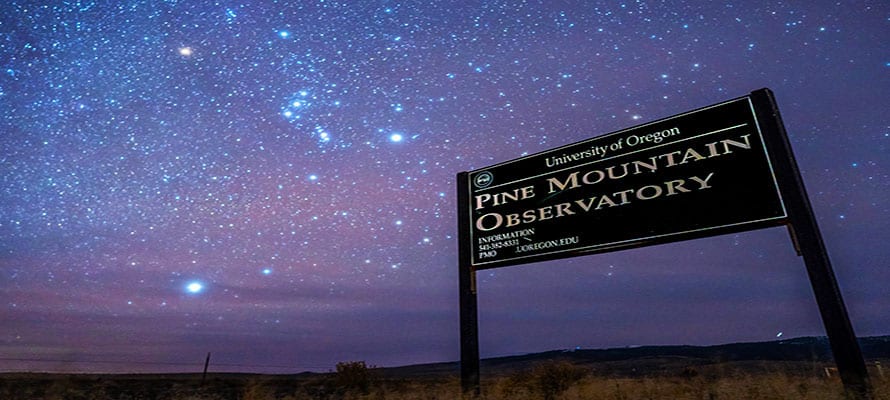
Friends of Pine Mountain Observatory
http://pmo-sun.uoregon.edu/~pmo/
The sky is a huge place filled
with many objects that we are just starting to understand. Due to
modern digital imaging technology, you can join the professionals in the
mission of exploration!
GOALS: by the end
of our session you will be able to:
a. Operate a CCD
Camera & explain how the camera works.
b. Measure digital
data & draw conclusions about space.
SESSION NOTES:
1. Good news and
bad news about gathering data from deep space: Data comes to
us in the form of ________________. There are lots of
photons because there are lots of ___________, which are ______.
But, due to the large distances, the photons _____ ______, making
what we look at appear very _______.
2. Gathering data:
two methods to collect photons:
a. _______________
gather photons over a large area.
The mirror or objective lens gathers and __________ light.
b. Cameras gather
photons over a __________ _____ _________.
3. Take some images
with our Charge Coupled Device (CCD) Camera.
These digital images
can be ___________.
The CCD Chip is a grid of
_________ - ___________ cells.
Within each cell, __________
are knocked loose by incoming __________. Then the electrons are
_____________.
Therefore, you can accurately
measure the _____________ and ___________ of each tiny box within
the silicon grid.
(continued...over .)
MEASURING the SKY - An
Introduction to Digital Astronomy 2000-2001
Side 2 of 2
4. What can we measure
about the sky?
a. How are objects
distributed across the sky?
Can we easily count them?: _____ _____ _____
_____
What
do our results indicate? We live in a _____________.
b. Do some objects
move relative to other objects?
We need to ____________ ______ __________.
An object that "jumps" position in a short period
of time must be much _________ than the other
objects. This object could be an ____________,
and is within our ___________ ____________.
c. What else may be
"hiding" out there?
More distant objects will probably appear ________.
To view these objects, we should set our camera
to gather photons for a ___________ period of time.
With increased exposure time, we begin to view
other ____________ way in back of the foreground
stars of our own Milky Way galaxy.
By measuring the brightness of a star or galaxy
(photon count, after correcting for "noise" from the
instrument and from the sky), we can start to figure
out the _______________, _____________, ___________,
_________, __________, __________, and ____________ of
an object far, far away!
Check out the Hubble
Deep Field image on the Internet, to see the farthest any human has
yet seen into deep space!
We live in a really big Universe!
|